By Mohamed Miah
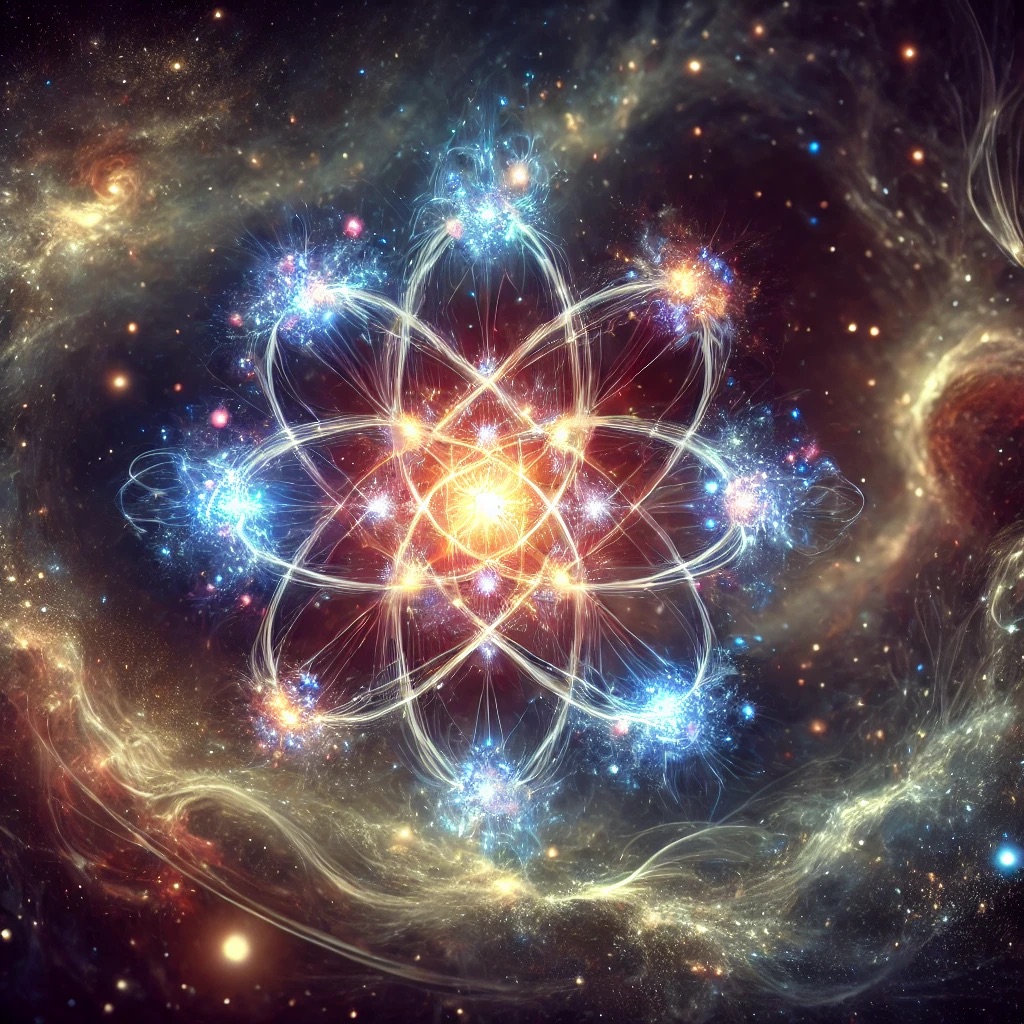
In our vast existence, every atom plays its part. We often view death as an end, a cessation of life, where our physical forms disintegrate and return to the earth. But what if death is not an end, but a continuation—a transformation rather than a termination? What if, as our bodies break down, the very atoms that once made us who we are persist, still jumping around in the cosmic that God, the all-knowing and all-powerful, choreographed?
This idea, rooted in both scientific principles and spiritual reflection, invites us to reconsider our understanding of life, death, and god. It’s a notion that brings together the cold logic of science and the warm embrace of faith, offering a perspective that is both humbling and awe-inspiring.
Science teaches us that matter cannot be created or destroyed, only transformed. The atoms that make up our bodies today were once part of ancient stars, long-extinct creatures, and primordial oceans. When we die, our bodies decompose, but the atoms remain. They disperse, becoming part of the soil, the air, and the water, continuing the cycle of life. In this sense, we never truly disappear. We simply change form, contributing to the ongoing story of the universe.
For those who believe in an all-knowing, all-powerful God, this scientific truth takes on a deeper meaning. In Islamic theology, it is believed that not even an atom moves without God’s knowledge or command. Every part of creation, no matter how small, is under His watchful eye. This means that even as our atoms disperse, they do so under God’s will. He knows where each one goes, and He has the power to bring them together again.
This belief aligns with the Islamic concept of resurrection on the Day of Judgment. The Qur’an frequently speaks of God’s power to bring the dead back to life, to reassemble the scattered bones and reconstitute the human form. God created the universe and everything within it from nothing, which means he can gather our dispersed atoms and recreate us with our unique genetic makeup. This is not just a matter of faith but a testament to the belief in God’s infinite power and knowledge.
Yet, this idea can also be seen from a more metaphorical perspective. What if paradise is not just a place, but a state of existence? A state where every atom, every particle, is in perfect harmony with the divine will? In this view, the atoms that once formed our bodies could experience paradise in a way that transcends our earthly understanding. After all, if God wills it, anything is possible.
This reflection challenges us to see life and death not as opposites, but as parts of a continuous journey. Our physical forms may change, but our essence—our atoms—remains part of the grand design. It is a perspective that brings comfort, knowing that even in death, we are still part of something greater, still under the care and guidance of the Creator.
In the end, this contemplation is not just about understanding the science of life and death or reaffirming religious beliefs. It is about embracing the mystery of existence, recognising the interconnectedness of all things, and finding peace in the knowledge that we are never truly lost. We are, and always will be, part of the eternal dance of atoms—each step guided by the hand of God.


 The Narratives - Mohamed Miah
Leave a reply to Mohamed Miah Cancel reply