By Mohamed Miah | The Narratives
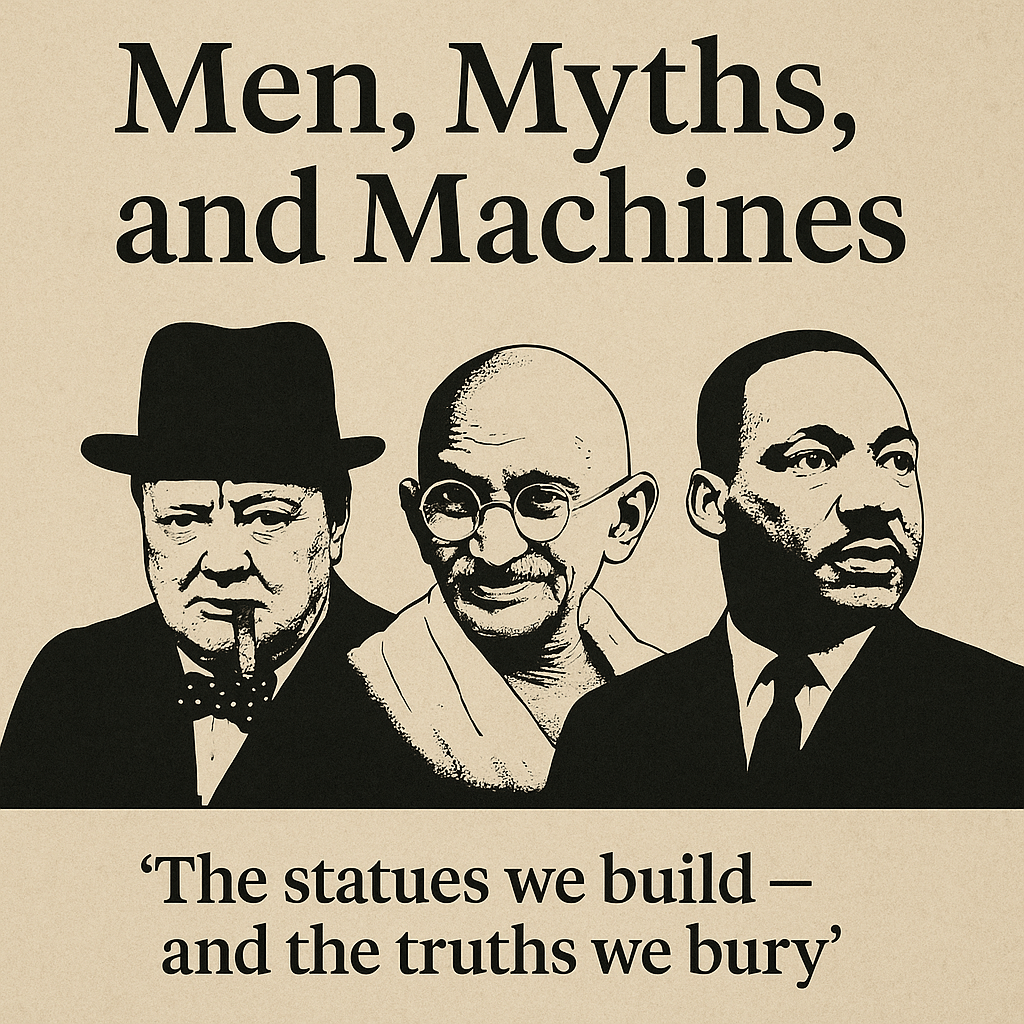
The statues we build — and the truths we bury
History has a funny way of favouring the brand over the man. Of editing blemishes, smoothing out contradictions, and polishing flawed figures until they’re gleaming icons for textbooks, street names, and public holidays. But the more I reflect, the more I realise — some of the most celebrated men in our history were never really “of the people.” They were wealthy, powerful, and dangerously self-important. What we remember today isn’t who they were. It’s who they needed to be for the machine.
Winston Churchill. Mahatma Gandhi. Martin Luther King Jr.
Men turned into myths.
Myths turned into machines.
Churchill The Empire’s Bulldog
Churchill is venerated like a saint in Britain — the cigar, the V-sign, the speeches that supposedly “saved the world.” But behind the wartime branding was a cold, calculating imperialist. He wasn’t just a man of his time — he was a man who actively crushed the futures of millions. In Ireland, he endorsed brutal force, backed partition, and helped unleash the Black and Tans, who terrorised civilians. In India, he let 3 million Bengalis starve in 1943 while hoarding grain for white soldiers. His response? “They breed like rabbits.”
And yet, statues of him stand tall. Schoolchildren are taught to revere him without ever learning about the brown and black lives he saw as disposable. That’s the thing about the empire — it didn’t just conquer with rifles. It conquered with storytelling. With mythology. With selective memory.
Gandhi The Mahatma with a Marketing Team
I’m not saying Gandhi did nothing. But let’s be real — without the bloodshed of India’s real revolutionaries, without the fire of Bhagat Singh, the courage of Subhas Chandra Bose, and the sacrifice of nameless villagers, Gandhi would’ve been just another moral philosopher in sandals. His early writings in South Africa are hard to stomach — he called Black Africans “kaffirs,” argued that Indians were superior, and didn’t want to be “classified with the natives.” That’s not liberation. That’s hierarchy wrapped in dhoti cloth.
And yet he was smart — he stripped himself of luxury clothing, dressed like the poor, and turned himself into a symbol. A brand.
But it was performance. Carefully staged.
He didn’t come from poverty. He came from privilege.
King The Palatable Face of Black Resistance
Martin Luther King Jr. had a voice that shook walls. But that voice was allowed to echo because it was more acceptable than the fury of Malcolm X or the militancy of the Panthers. King came from a middle-class background, was educated, polished, and respected in church circles. He was brilliant — but he was also safe for white liberals to get behind.
And while his legacy is important, it’s dishonest to pretend he did it alone. Without the anger in the streets, without the broken bones and tear gas and sit-ins by thousands of unarmed, nameless Black Americans — King’s dream would’ve remained a whisper.
The Lie of “British Morality” and the End of Slavery
Another myth we’re spoon-fed is that Britain “led the world” in abolishing slavery — out of morality and conscience. That’s hilarious.
Britain ended slavery because it became less profitable.
The Industrial Revolution meant machines were cheaper than slaves. That’s it.
2.5 million Indian soldiers fought in WWII for Britain. 600,000+ African soldiers were dragged into European wars they didn’t start. Millions more built the empire’s railways, dug its mines, and fed its colonies — only to be erased from the photo albums of history.
When Britain abolished slavery, they compensated the slave owners, not the enslaved. The debt from that compensation was paid off by taxpayers in 2015. Think about that.
The enslaved? They got nothing. Not even acknowledgement.
And those who fought for freedom — the Maroons, the African warriors, the Indian rebels — they were labelled terrorists, rebels, or savages.
Sold From Within
Here’s the harshest truth, many of us were betrayed by our own.
In Africa, some tribal leaders sold their rivals and even their own people to European traders for weapons and goods. In India, local kings and nawabs welcomed the East India Company with gifts and alliances — until they were swallowed whole.
History isn’t just about being conquered. Sometimes, it’s about being sold out by people who looked like you.
The empire didn’t always need force. It just needed a few well-placed cowards, a few greedy kings, a few selfish merchants. The same way today’s leaders sell land, water, faith, and identity for a seat at someone else’s table.
The Power of Symbols
And yet… people held onto hope.
Churchill gave some people strength in wartime, even if he was racist to the bone. Gandhi gave the illusion of non-violent dignity, even if others died violently all around him. King gave words to the oppressed, even if many of his own were ignored.
The myth became the medicine.
And maybe that’s the saddest part — the world was so starved of justice that even a hollow symbol gave it something to believe in.
We Remember the Mascots, Not the Movement
In the end, the world doesn’t reward truth. It rewards branding.
We remember Columbus for “discovering” a land that already had nations.
We remember Churchill for “saving” a democracy he himself denied to half the world.
We remember Gandhi and King for being the acceptable faces of liberation, while those who bled quietly were forgotten.
Men became myths.
Myths became machines.
And the people?
The people got edited out.
 The Narratives - Mohamed Miah
Leave a comment