By Mohamed Miah
When you think of prayer, what comes to mind? For most, it’s a quiet affair—hands clasped, heads bowed, sitting silently in pews, or whispering softly into the void. But here’s the truth: this isn’t how the prophets prayed. Not Abraham, not Moses, not Jesus. The prophets didn’t just speak their prayers—they moved. They stood, bowed, and prostrated themselves on the ground in total submission to God.
It’s right there in the scriptures, yet it’s rarely spoken about. The Torah shows Abraham falling to his face in worship. Moses bowed his head to the earth and prayed. Elijah bent low, placing his face between his knees. Jesus prayed with his forehead to the ground.
And here’s where it gets uncomfortable: the only people preserving this prophetic way of prayer today are Muslims in their daily Salah.
The question isn’t, “Why do Muslims pray like this?” The question is, “Why did everyone else stop?”
The Torah and Bible: Prayer Was Physical
If you’ve never looked closely, the evidence might surprise you. Across the Torah and the Bible, prophets didn’t just pray quietly—they physically submitted to God in worship:
1. Abraham (Ibrahim, peace be upon him)
“Abram fell on his face, and God talked with him…”
— Genesis 17:3
Abraham, the father of monotheism, fell face down before God—an act of complete humility and surrender.
2. Moses (Musa, peace be upon him)
“And Moses quickly bowed his head toward the earth and worshipped.”
— Exodus 34:8
When Moses encountered the divine, he bowed to the ground immediately. There’s no mistaking the physical nature of this act—Moses didn’t sit quietly; he lowered himself before God.
3. Joshua
“And Joshua fell on his face to the earth and worshipped, and said to Him, ‘What does my Lord say to His servant?’”
— Joshua 5:14
Joshua, the leader who succeeded Moses, fell face to the ground when speaking to God, reflecting the same reverence and submission as Abraham and Moses.
4. Elijah
“Elijah climbed to the top of Mount Carmel, bent down to the ground, and put his face between his knees.”
— 1 Kings 18:42
Elijah’s prayer is striking—he bent down so low that his face was between his knees, a posture of deep humility resembling Sujood in Islam.
5. Jesus (Isa, peace be upon him)
“He fell on his face and prayed…”
— Matthew 26:39
Jesus, in the Garden of Gethsemane, fell on his face before God. This was not a quiet, passive prayer. It was physical, intentional, and filled with submission.
Why Did It Change?
If this was the way the prophets prayed—if they bowed, prostrated, and physically submitted to God—why did these practices disappear?
1. Cultural Shifts: As Christianity spread into Greece and Rome, it adapted to local customs. Greeks and Romans, unfamiliar with prostration, viewed it as “undignified” or “uncivilised.” Standing or kneeling replaced the bowing and prostration described in scripture.
2. Church Authority: Over time, worship became formalised and institutionalised. Prayer was no longer a direct, physical act of submission but a ritual guided by the clergy.
3. Colonial Biases: During colonial times, physical acts of worship—particularly prostration—were dismissed as primitive. Hollywood reinforced this, portraying prostration as something “foreign” or “backward,” often associating it with idolatry or oppressive cultures.
These shifts weren’t accidental. They were part of a broader redefinition of worship, one that moved away from the prophetic example.
Who Still Prays Like the Prophets?
If you want to see the prayers of Abraham, Moses, Jesus, and Elijah in action today, you’ll find them in Salah—the prayer performed by Muslims.
Every movement in Salah mirrors the prayers of the prophets:
• Standing (Qiyam): Acknowledging God’s greatness.
• Bowing (Ruku): Lowering oneself in humility.
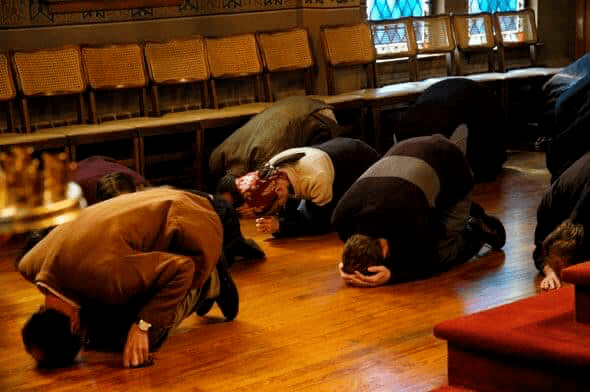
• Prostrating (Sujood): Placing the forehead to the ground in complete surrender to God.
Muslims perform this prayer five times a day, standing shoulder to shoulder, facing the Kaaba—the house rebuilt by Abraham and Ishmael as a centre of monotheistic worship.
This isn’t an innovation. It’s a living continuation of the way prophets prayed.
The Power of Prostration
At its core, prayer is about humility. It’s about recognising that we are small before God’s majesty.
Prostration is the ultimate physical act of humility. It strips away pride and arrogance. It reminds us that, no matter how high we think we’ve risen, we always return to the ground.
When you prostrate, your forehead—symbolising intellect, dignity, and pride—touches the earth. Your body aligns with your heart, and you acknowledge a truth that words alone can’t express: “I am nothing before You, my Creator.”
Reclaiming Real Prayer
If the prophets prayed like this—if Abraham, Moses, Elijah, and Jesus all bowed and prostrated—why don’t you?
This isn’t about religion versus religion. It’s about truth. It’s about reconnecting with the prophetic way of worship that has been preserved through Salah.
Imagine for a moment what it would mean to pray like that. To not just whisper words but to fall to the ground. To not just think about God but to physically submit yourself to Him.
Prayer, at its best, is transformative. It humbles you. It connects you. It moves you.
A Final Thought
The prophets didn’t pray quietly with their hands folded. They stood, they bowed, and they fell to the ground. This isn’t strange. It isn’t foreign. It’s the way prayer was always meant to be.
So the next time you kneel, whisper, or reflect, ask yourself:
What would it mean to truly follow the prophets? To stand, bow, and prostrate before God as they did?
Maybe it’s time we stopped asking why others pray like this and started asking ourselves:
“What have we lost by not praying this way?”


 The Narratives - Mohamed Miah
Leave a comment