By Mohamed Miah
In 1969, the world watched in awe as Neil Armstrong and Buzz Aldrin became the first humans to walk on the moon. The event was hailed as a triumph of human ingenuity, scientific progress, and the limitless possibilities of space exploration. It marked the culmination of years of effort to push the boundaries of what was possible, a testament to the power of science. But decades later, with technology advancing faster than ever, an unsettling question lingers: why haven’t we returned?
There are technical explanations—shifting priorities, budget cuts, and the need to develop new infrastructure. Yet, deeper questions emerge. If technology has improved exponentially, why does reaching the moon again seem harder now? And why are the photographs we capture in space often so disappointingly unclear when cameras on Earth produce such incredible images? These questions fuel scepticism. Some argue that the original moon landings never happened at all. They suggest that what we saw was an elaborate performance, a political show during the Cold War.
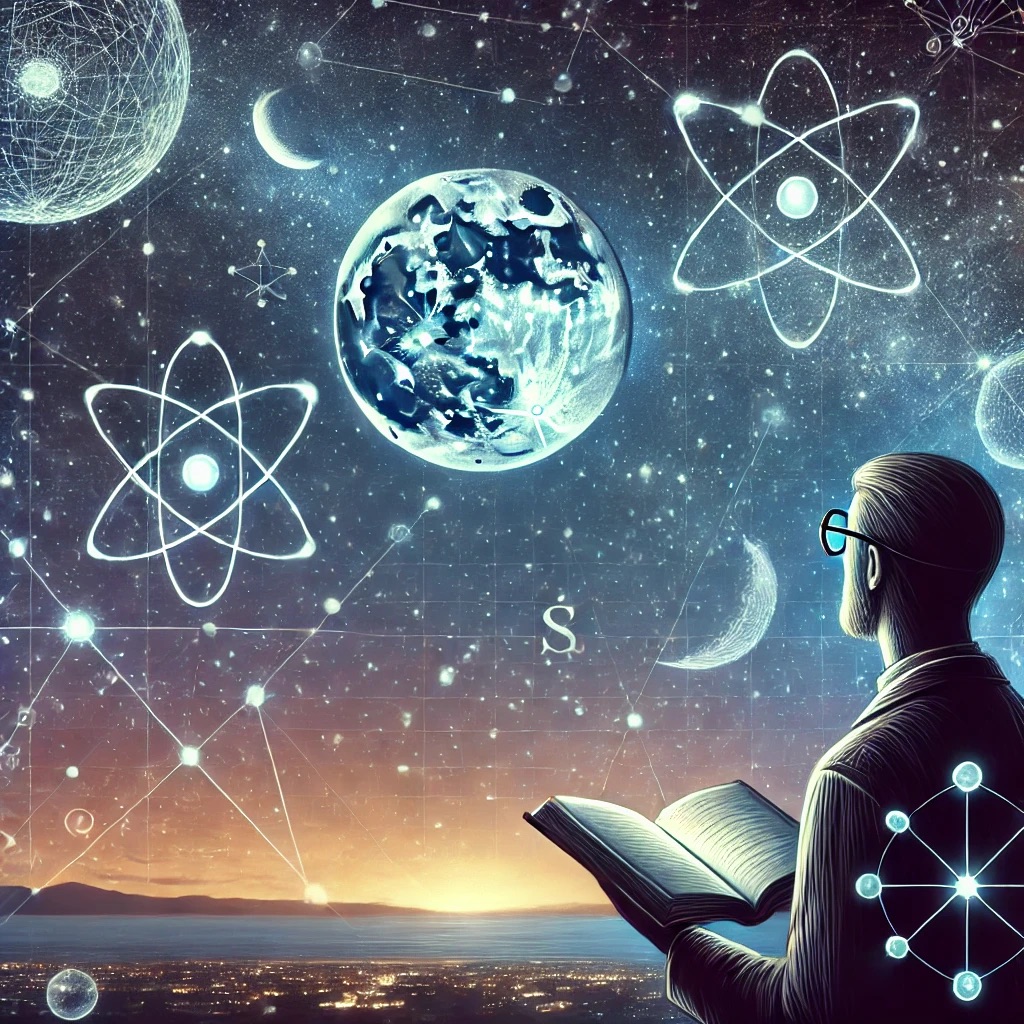
But what if this scepticism reveals something more profound about our nature? What if the pursuit of space, dark matter, and the intricacies of the universe reflects not just curiosity, but an intrinsic, spiritual search for answers—answers about our existence, our purpose, and ultimately, about God?
A Search for Meaning
From the dawn of time, humans have looked to the stars not just to understand their mechanics, but to answer existential questions: Who are we? Why are we here? For centuries, science and faith have been perceived as opposing forces, locked in a battle for supremacy. But the reality is much more nuanced. Science, at its core, is about uncovering the how—how the universe works, how life evolves, how matter interacts. Faith, on the other hand, grapples with the why. Why does the universe exist? Why is there something rather than nothing?
Many scientists, in their pursuit of discrediting the notion of a higher entity, are often led right back to the doorstep of God. The more they delve into the complexities of the universe, the more they encounter mysteries that defy purely material explanations. The universe is not random. It is governed by precise, fine-tuned laws that allow life to exist. From the design of DNA to the origins of consciousness, the evidence always points to an intelligent design.
It’s not just about filling gaps in knowledge with “God did it” explanations, a critique often levelled at believers. Instead, it’s about acknowledging that there are limits to human understanding—limits that science, for all its brilliance, cannot transcend. Many scientists who began their careers as atheists or agnostics, driven by the desire to explore these limits, find themselves confronted by a reality that transcends materialism. The renowned physicist Albert Einstein once said, “The more I study science, the more I believe in God.” This is not blind faith, but a recognition of the profound order and purpose that underpins the universe.
A Closed Loop, Science and Faith Converging
The idea of a closed loop—where scientific inquiry inevitably leads back to faith—has become more pronounced in modern times. With each scientific breakthrough, more questions arise, questions that point to something greater than the material world. Consider the Big Bang theory, which suggests a beginning to the universe. What caused it? Why did it happen at all?
For believers, the Qur’an has long offered answers to these questions. It speaks of the creation of the heavens and the earth, encouraging reflection on the natural world as signs of God’s power. Remarkably, some of the descriptions in the Qur’an align with scientific discoveries made centuries later, particularly regarding the origins of the universe and embryology.
Sceptics may argue that such texts are open to interpretation, and indeed, questioning is part of human nature. But as science advances, it seems to provide more reasons to believe rather than to disbelieve. The journey of exploration, whether through space or atoms, consistently points to a higher purpose, something beyond mere chance.
The Moon, Retroreflectors, and the Search for Truth
Let’s return to the moon landings. Many argue that the moon landings were staged, citing the lack of high-quality images, the absence of stars in the photos, or the technical challenges of the time. They point out that even today, with vastly superior technology, we struggle to capture clear, definitive images of space. Is it because we’re hiding something? Is it because there was no human presence on the moon at all? Some suggest that even the retroreflectors placed on the moon—devices used to measure the distance between Earth and the moon—could have been sent by unmanned missions. After all, couldn’t a machine do what humans claimed to have done?
These arguments, however, skirt the larger issue. Whether we believe in the moon landings or not, what lies beneath the scepticism is a deeper search for truth and rational. It reflects a yearning to know who we are and why we are here. And this search, this scepticism, has always been tied to something more than just science—it’s been tied to our connection with God.
The Science of Belief
Many scientists embark on their journey with the goal of uncovering the mechanics of the universe, often with the underlying assumption that there is no higher power. Yet, the complexity they encounter—the fine-tuning of physical laws, the emergence of life from seemingly improbable conditions—often leads them to reconsider. The deeper they dig, the more they realise that science doesn’t disprove God; it reveals the beauty and order of creation.
In recent years, some scientists have turned to faith, recognising that the universe seems to operate according to a design that can’t be fully explained by randomness. For them, the more they understand the cosmos, the more they see the signs of a Creator. The universe, rather than being cold and indifferent, is imbued with meaning and purpose. It is a closed loop that always leads back to the same answer: we are part of something greater.
The Infinite Quest
The exploration of space, the study of dark matter, the investigation of atoms—all of these are driven by a desire to understand the unknown. Yet, in many ways, this scientific journey mirrors the spiritual quest for meaning. We want to know where we came from, where we are going, and why we exist. It is a quest that can never fully be satisfied by material explanations alone.
Perhaps that’s why so many scientists end up believing in God. Because at the end of the day, science can answer how the universe works, but it cannot answer why it exists. And the answer to that question, as many have discovered, lies in something far beyond the reach of human understanding. It lies in God.
The more we learn, the more we realise how much we don’t know. And perhaps, that is where faith begins.
 The Narratives - Mohamed Miah
Leave a comment