By Mohamed Miah
In a world increasingly dominated by science and technology, it’s easy to view numbers and equations as the ultimate arbiters of truth, stripped of any deeper meaning beyond their cold, calculated precision. Yet, for those who look closer, particularly through the lens of faith, mathematics reveals itself as more than just a tool for understanding the physical world—it emerges as a potential bridge to the divine.
Numbers like 3, 5, and 7 have long held special significance in religious traditions, particularly in Islam. These numbers appear repeatedly in Islamic teachings, subtly embedding themselves into the fabric of a Muslim’s spiritual life. The number 3, for instance, appears in the practice of wudu, the washing before prayer, where each part of the body is washed three times. The number 7 appears in the sacred act of Tawaf during Hajj, as pilgrims circle the Kaaba seven times. These are not arbitrary traditions but deeply symbolic actions that resonate with the believer’s sense of divine order.
But what if these numbers aren’t just significant within religious contexts? What if their importance extends beyond spiritual rituals into the very structure of the universe? This is where the lines between faith and mathematics begin to blur, suggesting that numbers are not as random as they seem.
Take prime numbers, for example—those elusive figures that can only be divided by 1 and themselves. To the untrained eye, prime numbers like 3, 5, 7, 37, and 73 might seem scattered randomly across the number line, devoid of any discernible pattern. However, mathematicians have long been fascinated by these numbers, recognising them as fundamental building blocks of arithmetic. Their unpredictability has made them crucial in fields like cryptography, where they help secure digital communication in an increasingly interconnected world.
Yet, for the faithful, the randomness of primes might be an illusion—a reflection of our limited understanding rather than their true nature. If we consider the divine creator, the existence of prime numbers, and their unique properties is be seen as part of a larger, divinely orchestrated design. These numbers are, in essence, the fingerprints of God, embedded in the very fabric of creation, waiting to be discovered by those who seek to understand the universe not just through reason, but also through faith.
This idea is not new. Throughout history, many scientists and mathematicians have viewed their work as a way to uncover the divine order of the universe. Isaac Newton, a devout Christian, believed that the laws of physics he described were not just natural phenomena but divine ordinances that governed the cosmos. Albert Einstein, who famously remarked, “God does not play dice with the universe,” saw the elegant laws of physics as a reflection of something greater, something beyond mere chance.
From this perspective, science and religion are not opposing forces but complementary ways of understanding the same truth. Where science uncovers the how, faith seeks to tell you why. And in the patterns of numbers, particularly in their most random forms, we find evidence of a higher purpose—a divine intelligence that has coded the universe in a language of numbers.
For believers, this view transforms the study of mathematics from a purely intellectual exercise into a form of spiritual exploration. Each new discovery, whether it’s a new prime number or a previously unknown mathematical pattern, becomes a small revelation of the divine order, a glimpse into understanding God.
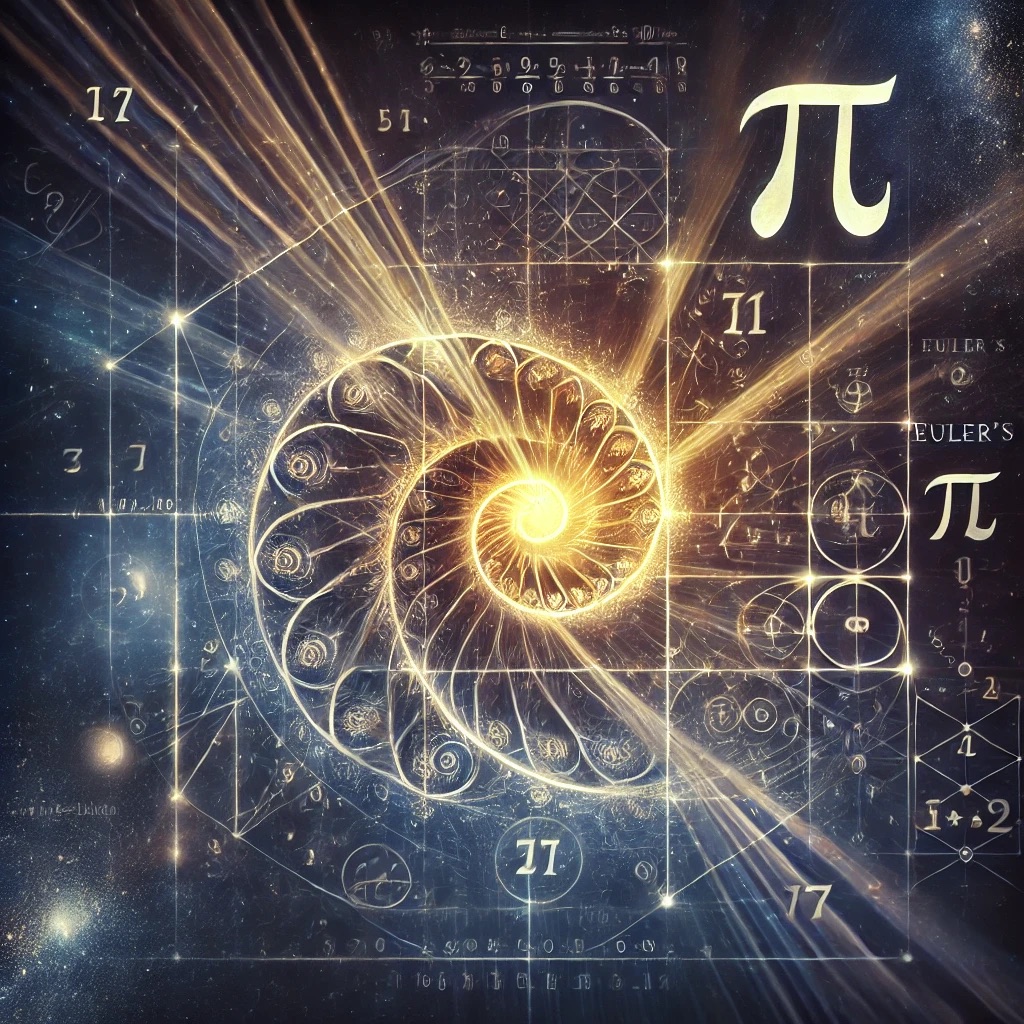
Of course, to the non-believer, this might all seem like a leap of faith—a way of imposing meaning on a universe that is indifferent to human beliefs. And yet, even in the secular realm, there is an undeniable sense of wonder in the mathematical patterns that underpin the world. The Fibonacci sequence, the golden ratio, the symmetry of fractals—these are all examples where mathematics reveals a beauty and order that transcends the mundane. Perhaps, in these moments of awe, even the most skeptical minds can feel a connection to something greater.
In the end, whether one sees numbers as divinely inspired comes down to personal belief. But for those who approach the world with both faith and reason, mathematics offers more than just answers to complex problems—it offers a way to glimpse the divine in the most unexpected places.
As we continue to explore the mysteries of the universe, let us remember that numbers, in all their simplicity and complexity, are more than just abstract concepts. They are, for those willing to see, the silent language of the divine, woven into the very fabric of existence.
 The Narratives - Mohamed Miah
Leave a comment