By Mohamed Miah
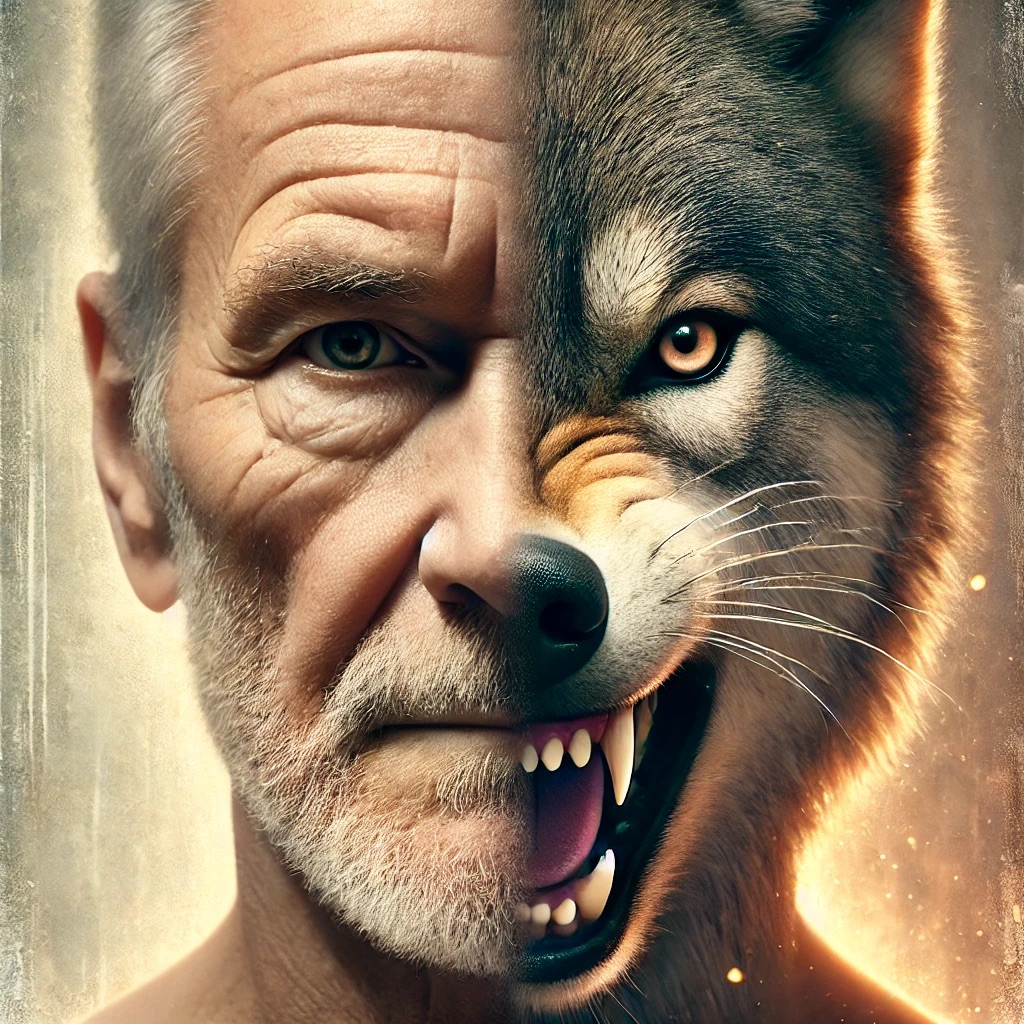
In human existence we often pride ourselves on the advances that set us apart from the animal kingdom—our intellect, our civilisations, and our capacity for reason. Yet, beneath these layers of sophistication, there lurk primal instincts that we share with our animal counterparts. The struggle for dominance, the drive for reproduction, and the responses to fear are as much a part of our nature as they are in any pack of wolves. What truly distinguishes us, however, is not merely our capacity for reason, but the transformative power of faith—a force that can elevate our instincts into something far greater.
In the natural world, hierarchies are established through power and dominance. The strongest wolf leads the pack, the most cunning lion claims the territory, and the fiercest primate reigns supreme. These are not just behaviors, but instincts honed by evolution for survival. In human societies, these instincts manifest in various forms—from corporate boardrooms to social circles—where the struggle for dominance can be just as fierce, albeit more subtle.
But while animals are bound by their instincts, humans possess an additional layer of complexity: the spiritual dimension. Faith, particularly the belief in the oneness of God, offers a path that guides us beyond our primal urges. It provides a moral framework that reshapes our instincts, channeling them into expressions of love, justice, and compassion.
Consider the primal drive of lust, an instinct shared with nearly all animals. In the absence of faith, this drive can lead to behaviors that are purely self-serving, reducing relationships to transactions of desire. However, within the context of faith, this same drive is transformed into an expression of love—a bond sanctified by commitment, respect, and spiritual union. In this light, what begins as a base instinct becomes an act of devotion, where the physical is intertwined with the sacred.
Similarly, aggression, a natural response to threats, is an essential survival tool in the animal kingdom. Yet in humans, faith tempers aggression, redirecting it into a sense of justice. Where primal aggression seeks to dominate, faith-driven justice seeks to protect, to uphold what is right, and to act with righteousness rather than wrath. This transformation is not merely a suppression of instinct but a rechanneling, where the energy of aggression is used to defend the vulnerable and maintain moral order.
Even fear, one of the most basic and powerful emotions, is reshaped by faith. In its primal form, fear leads to paranoia, retribution, and a defensive posture that can spiral into violence. However, within a spiritual framework, fear is elevated to reverence—an awe of the divine that fosters humility, gratitude, and a deeper understanding of one’s place in the universe. This reverence does not paralyse but inspires, guiding individuals to act in ways that align with higher principles rather than succumbing to baser impulses.
The contrast between those who live within a spiritual framework and those who rely solely on secular or instinctual drives is stark. For the latter, the absence of a divine moral compass can lead to an over-reliance on primal functions, where lust turns to exploitation, aggression to abuse, and fear to paranoia. This is not to say that secular individuals cannot be moral or compassionate, but rather that the absence of faith may leave them more vulnerable to the excesses of their instincts.
In contrast, faith acts as a form of reprogramming, a higher coding that moves us away from mere survival towards spiritual fulfillment. It teaches that life is more than the sum of our instincts, that we are called to rise above our primal nature and live in accordance with divine will. This struggle—between the animal within and the spiritual calling—is at the heart of the human experience.
At a time when society is increasingly secular, it is worth reflecting on what we lose when faith is sidelined. Without the guiding hand of spirituality, there is a risk that we revert to a more primal state, where the higher functions of love, justice, and reverence are overshadowed by their baser counterparts.
Ultimately, what sets humans apart is not just our capacity for reason, but our ability to transcend our instincts through faith. In this lies the true difference between us and the animals—a difference that is not just of degree, but of kind. Faith elevates us, turning primal drives into acts of worship, and instincts into opportunities for spiritual growth. It is this transformative power that makes us not just animals who think, but beings who seek to align their lives with the divine.
 The Narratives - Mohamed Miah
Leave a comment